
By Edward Torsney
The Guardian ran this article today:
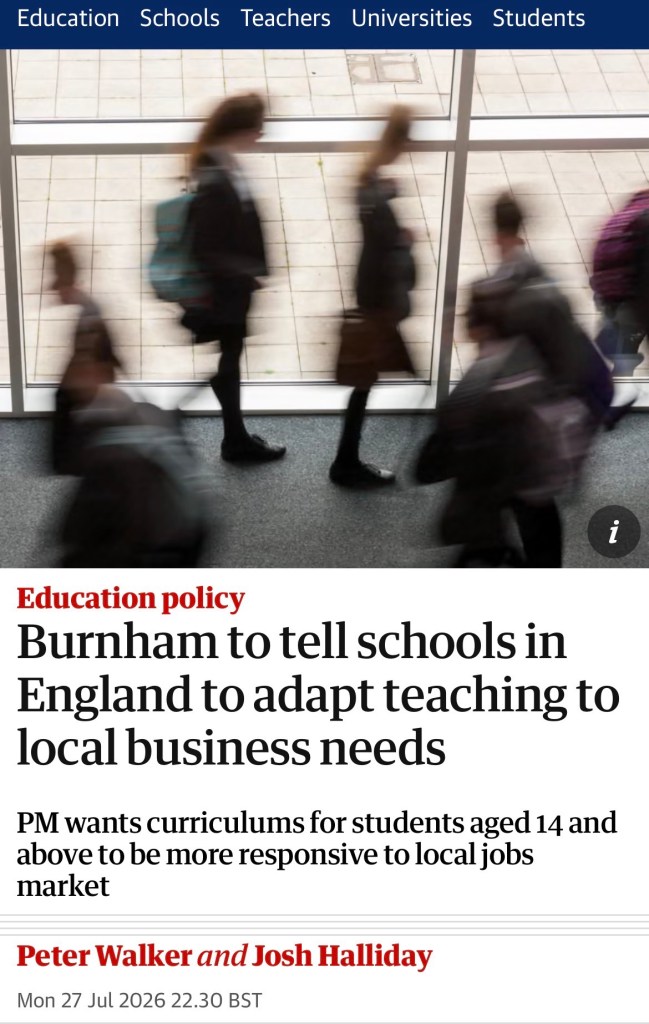
The headline framing is itself worth pausing on: schools are to “adapt” to “the needs of local business.” The verb ‘to adapt’ is a one-way action — schools adapt to business, not business to schools, not children to their own futures. The directional grammar of the policy tells you most of what you need to know about who is the subject and who is the object in this arrangement.
What the policy proposes
Andy Burnham, now Prime Minister, is described by No 10 as enacting “a fundamental change to the education system” — curriculums for pupils aged 14 and above are to be made “more responsive to the local jobs market,” with universities de-prioritised as the default destination and a “clearer pathway into work” foregrounded. The Guardian Education Secretary Lucy Powell frames it as “a real shared effort with employers, businesses, mayors and councils” — a coalition from which one party is conspicuously absent: the young people themselves. BBC News

Read generously, this is a recognition that the academisation-and-tuition-fees settlement failed working-class children, and that a vocational route deserves dignity. Read more coldly, it is something else: the formal subsumption of the school under the firm.
The child as human capital
The philosophical problem is not new. When Rousseau opened Émile with “Everything is good as it comes from the hands of the Author of nature; everything degenerates in the hands of man,” he was arguing against precisely the sort of education that shapes the child to a predetermined social slot. The child, for Rousseau, has a nature — a potential interior to the child — that education is to draw out (the Latin educere, to lead forth), not beat flat into a mould cut by employers in Greater Manchester or the Tees Valley.
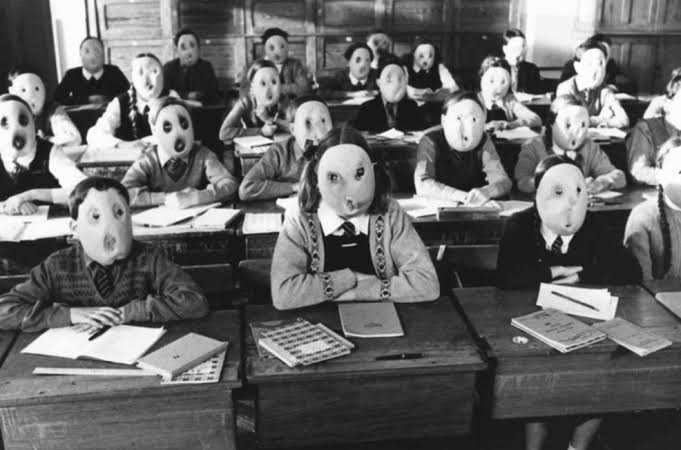
Burnham’s policy inverts this. The child is positioned not as a being to be educated but as a resource to be calibrated — a stock of future labour-power whose curriculum is to be tuned to the requirements of regional capital. This is the language of human-capital theory, the doctrine associated with Gary Becker, in which schooling is an “investment” whose “return” is measured in productivity and GDP. The slip is almost invisible: education ceases to be a good in itself and becomes a factor of production. The pupil becomes, in Ivan Illich’s phrase from Deschooling Society, a “schoolable” commodity — processed, certified, and delivered.
Bowles and Gintis, and the reproduction question
The most direct theoretical challenge to this kind of policy was mounted half a century ago by Samuel Bowles and Herbert Gintis in Schooling in Capitalist America (1976). Their thesis — that the correspondence between workplace hierarchy and classroom hierarchy reproduces class relations across generations — is sharpened, not softened, by Burnham’s turn. If the school’s job is to mirror the local labour market, then the “correspondence principle” is no longer an unintended side-effect of schooling but its stated purpose. A child in a former steel town is to be schooled toward the jobs that capital has chosen to locate there; the geography of exploitation is to be written into the timetable.

Pierre Bourdieu’s Reproduction in Education, Society and Culture deepens the indictment. The “cultural capital” transmitted by middle-class homes is, on this policy, to be supplemented — or replaced — by the economic capital of the local firm, whose needs now set the curriculum’s horizon. The poor child is not to be given the instruments to read the system that holds them in place; they are to be given the instruments to fit into it. Emancipation is redefined as employability. Befreiung becomes Brauchbarkeit — usefulness.
Emancipation, properly understood
The counter-tradition is also long. For Paulo Freire, writing from the favelas of Recife, education was “the practice of freedom” — the means by which the oppressed come to name the world and so to transform it. His Pedagogy of the Oppressed is explicit that an education which adapts the learner to oppression is not education at all but banking: the teacher deposits knowledge the better to withdraw labour. A Freirean reading of Burnham’s reforms would see a national-scale banking operation, with regional employers as the depositors.

The same current runs through the American John Dewey, hardly a Marxist, who insisted in Democracy and Education that “education is a process of living and not a preparation for future living.” To make the school a waiting room for the warehouse or the call-centre is to betray Dewey’s foundational claim — that the child is a citizen now, not an apprentice citizen later. And Marx himself, in the Critique of the Gotha Programme, demanded not technical training for industry but “technological education, theoretical and practical,” as part of the full development of the human being — the very development that Burnham’s instrumental turn forecloses.
Dickens, then and now
There is a reason Thomas Gradgrind still resonates. The opening of Hard Times — “Now, what I want is, Facts. Teach these boys and girls nothing but Facts” — is satire because it is also reportage. The Coketown schoolmaster’s pupils are “little vessels… ready to have imperial gallons of facts poured into them until they were full to the brim.” Substitute “labour-market skills” for “facts” and the copperplate reads like a press release from the Department for Education. Dickens’ point was not that facts are bad but that a child is not a vessel, a town is not a machine, and a school is not a feeder pipe for the mill.
A policy that orients the schooling of fourteen-year-olds toward “the local jobs market” repeats Gradgrind’s error with a regional gloss. The poor child in Burnham’s England is to be spared the indignity of unemployment by being given the dignity of pre-formation — shaped, before they know themselves, into the contour of an employer’s requirement.
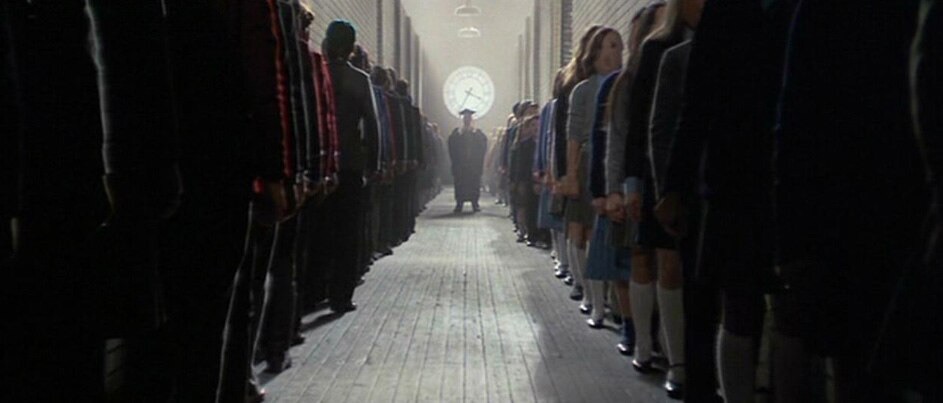
Is this servitude by design?
To ask whether the scheme is a deliberate plot to entrench the masses in service is, I think, to misframe the question. The most durable forms of domination do not require a cabal; they require only a settled common sense. As Raymond Williams argued in The Long Revolution, hegemony is not imposed from above but lived as “the basic beliefs and values” of a whole society — beliefs so ordinary they are invisible. The current settlement treats GDP growth, productivity, and “competitiveness” as self-evident ends, and within that frame Burnham’s policy is not radical but reasonable. That is what makes it dangerous.
Antonio Gramsci’s distinction is useful here. The school, in Gramsci’s reading of the Italian liceo, was to form “organic intellectuals” — people capable of elaborating their own worldview, of leading themselves. To reduce the school to a skills-conveyor for regional firms is to invert the Gramscian project: it produces what he called subalterns, those whose conception of the world is borrowed from the class that rules them. The poor child trained for the local employer does not become an organic intellectual of their own condition; they become a, cittadino subalterno — a citizen whose terms of self-understanding are set elsewhere.
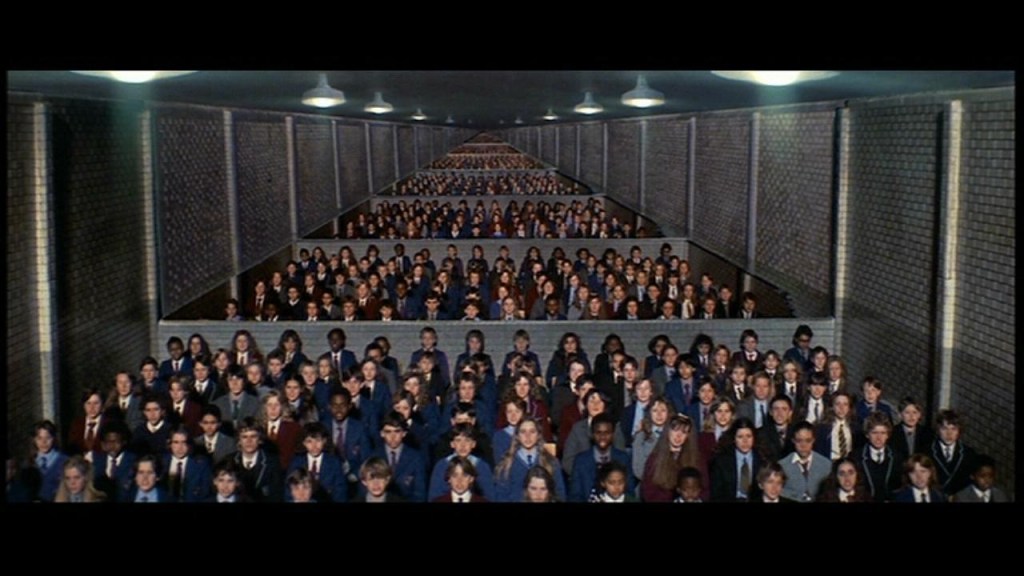
The structural question that the policy cannot ask
What is genuinely absent from the announcement — and from Lucy Powell’s “shared effort with employers, businesses, mayors and councils” — is the question Freire, Bowles and Gintis, and Marx all insisted on: why is there a “local jobs market” at all, and who designed it? Why are some towns warehouses and others finance houses? Why do fourteen-year-olds in Hartlepool face a different curriculum from those in Kensington, and is that difference a fact of nature or a fact of property? The policy treats the geography of capital as weather — something to be adapted to, not something to be explained or contested.
An emancipatory education would do the opposite. It would teach the child in the former mining town not only the skills the local employer requires but the history of why that employer is there and the next town over is not — the history of deindustrialisation, of capital flight, of policy choice. It would give the child the critical apparatus to read their own position as constructed, and therefore as changeable. As Giroux has argued across four decades, this is the difference between education for vocational training and education for civic courage.
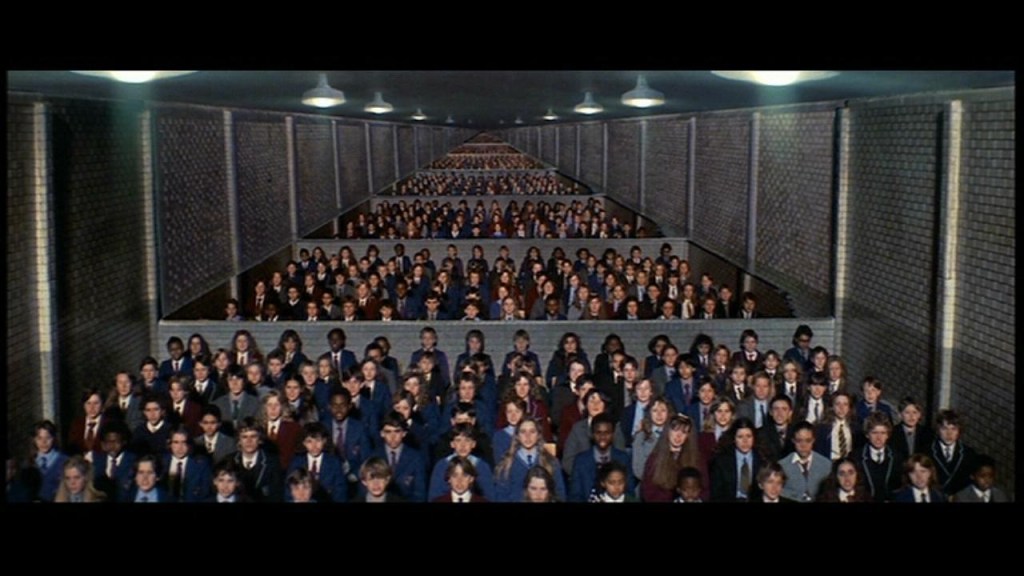
The narrowed horizon
Burnham’s policy is not, I think, a scheme hatched by bosses to groom children into servitude. It is something more banal and more durable: the naturalisation of the economic order as the educational order, dressed in the language of opportunity. The rhetoric of “clearer pathways into work” sounds generous because it is generous — within the horizon the policy permits. That horizon is the labour market as given. Outside it lie all the questions the policy cannot ask: about ownership, about why work is organised as it is, about what a child might become if their education were not already answerable to a firm.
The danger is not conspiracy; it is the closing of the educational space in which conspiracy could even be conceptualised. When the school’s telos is the local employer, the child is educated into the structure rather than toward the capacity to see it. They are fitted, in the carpenter’s sense — fitted to a place already prepared. The old word for a person so fitted is serf, and the old word for the system that fits them is feudalism; the new words are employability and skills agenda, and they sound kinder, which is how domination usually sounds when it has won.

What emancipation would require — what Rousseau, Dewey, Freire, and Gramsci each in their way demanded — is the inversion of the verb in Burnham’s headline. Not schools adapting to the needs of business, but business held answerable to the needs of the young, who are not a resource but the inheritors of the world they will, one day, have to remake.

Article by Edward Torsney 2026


Leave a comment